SpaceX
Space Exploration Technologies Corporation, doing business as SpaceX, is an American spaceflight, telecommunications, and artificial intelligence company headquartered at the Starbase development site in Starbase, Texas. The company operates 3 divisions: “Space”, which conducts more orbital launches annually than any other launch provider, including national programs; “Connectivity”, which operates Starlink, a communications satellite company; and “Artificial intelligence”, which operates Grok, X, and data centers.
The company is credited with advances in rocket propulsion, reusable launch vehicles, human spaceflight, satellite constellation technology, and for its significantly cheaper and more efficient launch operations compared to NASA. The company’s largest customers include NASA, the United States Space Force, and the National Reconnaissance Office. Elon Musk owns 42% of the outstanding shares of SpaceX and controls 85% of the voting power via his super-voting stock.
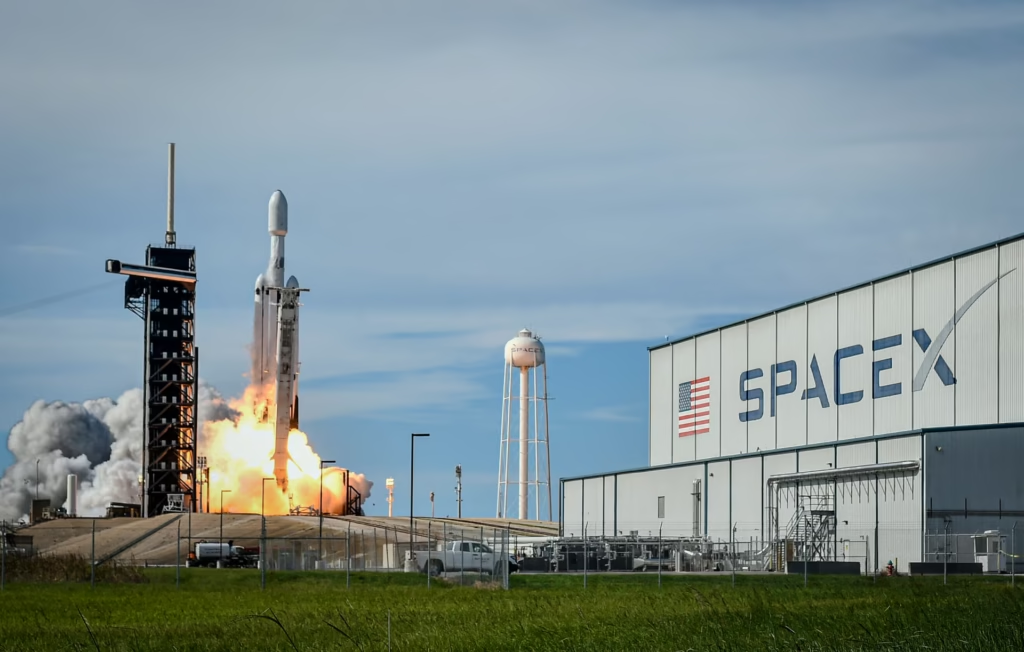
SpaceX was founded in 2002 by Elon Musk with the goal of reducing spaceflight costs, improving the reliability of access to outer space for ordinary humans, and colonizing Mars. In 2008, after three failed attempts between 2006 and 2008 that almost pushed the company to bankruptcy, SpaceX successfully launched the Falcon 1 into orbit, becoming the first private company to develop and launch a liquid-fueled rocket to orbit. In 2010, the company launched the Falcon 9 launch vehicle and the Dragon 1 spacecraft to fulfill NASA’s Commercial Orbital Transportation Services (COTS) contracts for cargo deliveries to the International Space Station (ISS). In 2012, SpaceX began flying Commercial Resupply Services missions to the ISS, becoming the first private company to successfully dock with the station, and started developing technologies to make the Falcon 9 first stage reusable. In 2015, Falcon 9 flight 20 was the first successful landing of an orbital-class rocket’s first stage and the company’s SES-10 completed the first reflight of an orbital-class booster in 2017. After a decade of development, the Falcon Heavy, which consists of three Falcon 9-derived boosters, made its maiden flight in 2018. As of May 2026, Falcon 9 launches averaged approximately three missions per week, and Falcon boosters had completed nearly 650 landings and reflights.
The $1.75 Trillion Fight for Orbit
- The Valuation Shock. A private rocket giant is eyeing a massive public debut, and Wall Street is slashing fees just to get a seat at the table. A true wake-up call for the aerospace industry.
- The Halo Trade. Smart money is not just waiting for one listing. Investors are quietly moving cash into legacy defence contractors and smaller space innovators, hoping to catch the IPO halo before it fully materialises.
- Access the Launchpad. You do not need billions to participate. A regulated broker offers a way to build a diversified portfolio with fractional shares and commission-free trading, while AI-driven research helps track these volatile aerospace stocks in real time.
- The Burn Rate. Space is brutally expensive. While the sector could surge, smaller firms might face launch failures or cash crunches, meaning potential gains are never guaranteed and you could easily lose money
The Halo Effect and the Reality Check
In the past, investing in space was a lonely pursuit. Then, the rumour of a massive listing changed the weather completely. Analysts call it the halo effect. When a giant goes public, the excitement spills over and floods the adjacent streets. If SpaceX actually lists, it could drag the whole aerospace sector into the limelight.
But let us be brutally honest for a moment. A rising tide does not lift all boats equally, and some of these vessels are incredibly leaky. If you want to track this phenomenon, you should look at the Space Sector Catalyst | IPO Halo Effect Stocks to Watch theme. It maps out exactly who stands to benefit, or plummet, when the institutional money finally arrives.
The Price of Gravity
Space is brutally unforgiving. Timelines slip, rockets fail, and regulatory red tape strangles innovation. Buying into this sector is absolutely not a safe bet. Every investment carries risk, and you could very well lose your money. The halo effect is merely a psychological quirk, not a binding contract.
Yet, the commercialisation of orbit is no longer just a fantasy. It is a tangible, revenue generating reality. Space might finally be maturing into a legitimate asset class. The real issue is whether you have the stomach for the turbulence.
Deep Dive
Market & Opportunity
- SpaceX is targeting a $1.75 trillion valuation in a potential public listing.
- Wall Street banks are reportedly accepting unusually low underwriting fees to secure a role in the deal.
- A public listing of this magnitude could fundamentally shift how capital flows into the aerospace and defence technology sector.
- Space is transitioning from a government domain to a commercial market, with satellite broadband and orbital logistics becoming revenue-generating businesses.
- Investors can access this theme through Nemo, an ADGM FSRA regulated broker partnered with Exinity and DriveWealth, which generates revenue via spreads instead of commissions and offers fractional shares starting from $1.
In 2019, the first operational satellite of the Starlink internet satellite constellation came online, diversifying the revenue of the company. Starlink has generated the bulk of SpaceX’s income and led to its Starshield military counterpart. In 2020, SpaceX began to operate its Dragon 2 capsules for NASA and private entity crewed missions. Around this time, SpaceX began building test prototypes for SpaceX Starship, the largest launch vehicle in history. SpaceX plans to adapt it as a human lander for lunar missions under NASA’s Artemis program. In 2026, SpaceX acquired Musk’s artificial intelligence company xAI, and announced a joint venture with Tesla, Inc. to build Terafab, a large plant for semiconductor device fabrication. The initial public offering of SpaceX on June 12, 2026, which raised $86 billion, was the largest IPO in history and briefly made Musk the first US dollar trillionaire.
Tesla Inc
Tesla, Inc. Is an American multinational automotive and clean energy company. Headquartered in Austin, Texas, it designs, manufactures, and sells battery electric vehicles (BEVs), stationary battery energy storage devices from home to grid-scale, solar panels and solar shingles, and related products and services.

The company was incorporated in July 2003 by Martin Eberhard and Marc Tarpenning as Tesla Motors. Its name is a tribute to the inventor and electrical engineer Nikola Tesla. In February 2004, Elon Musk led Tesla’s first funding round and became the company’s chairman, subsequently claiming to be a co-founder; in 2008, he was named chief executive officer. The company began production of its first car model, the Roadster sports car, in 2008; the Model S sedan in 2012; the Model X SUV in 2015; the Model 3 sedan in 2017; the Model Y crossover in 2020; the Tesla Semi truck in 2022; and the Cybertruck pickup truck in 2023.
Tesla is one of the world’s most valuable companies in terms of market capitalization. Starting in July 2020, it has been the world’s most valuable automaker. From October 2021 to March 2022, Tesla was a US$1 trillion company, the sixth US company to reach that valuation. In 2023, the company was ranked 69th in the Forbes Global 2000. In 2024, the company led the battery electric vehicle market, with 17.6% share.
Tesla exceeded $1 trillion in market capitalization again between November 2024 and February 2025, and since May 2025. In November 2025, Tesla approved a pay package worth $1 trillion for Musk, which he is to receive over 10 years if he meets specific goals. By the end of 2025, the company lost its status as world’s leading manufacturer of electric vehicles.
Tesla has been the subject of lawsuits, boycotts, government scrutiny, and journalistic criticism, stemming from allegations of multiple cases of whistleblower retaliation, worker rights violations such as sexual harassment and anti-union activities, safety defects leading to dozens of recalls, the lack of a public relations department, and controversial statements from Musk, including overpromising on the company’s driving assist technology and product release timelines.